

Growth vs. Profitability on Amazon: The Dilemma and What to Do Next
The Amazon Landscape Has Changed
There was a time when growing on Amazon felt more straightforward. If a brand understood the platform, executed strong growth tactics, and priced competitively within its category, scaling revenue was a clear and achievable goal.
Today, the environment looks very different. Competition is heavier, top performers are more established, and brands must navigate changing fee structures, inventory pressures, and rising advertising costs that make growth more complex than ever.
When brands commit to Amazon, the initial focus is often rapid growth. But the “growth at all costs” playbook no longer works for most sellers. Growth is still possible—but it increasingly requires a more balanced, profitable, and sustainable approach.
As a result, we’re seeing a clear shift in mindset. More brands are asking a fundamental question:
Should I prioritise growth or profitability?
Growth-First vs. Profit-First Strategies
On Amazon, most strategies fall into one of two categories: growth-first or profit-first. Both can work — but they require different priorities, metrics, and expectations.
A growth-first strategy typically focuses on:
- Increasing market share
- Improving organic & category rankings
- Expanding keyword visibility
- Driving top-line revenue
- Increasing unit velocity relative to competitors
- Attracting new customers
A profit-first strategy, on the other hand, prioritises:
- Margin protection
- Advertising efficiency
- Sustainabilit
- Brand representation and customer experience
- A long-term, curated product strategy
Many brands assume profits will naturally follow growth. On Amazon, that isn’t always true.
When Growth Makes Sense (and When It Doesn’t)
For new products and early-stage brands, a growth-first strategy is often necessary. Breaking even — or even operating at a loss — during the first 12–24 months can be expected, especially if the brand lacks established branded search volume. In this phase, growth builds visibility, reviews, and organic ranking. It’s an investment period.
But after 2–5 years in the market, the equation changes.
If growth has stalled, it’s worth examining year-over-year search volume trends. Is category demand flattening? Are consumer interests shifting? In mature markets, chasing revenue growth at the expense of profit can become inefficient — and sometimes destructive.
Markets evolve. Competition intensifies. At a certain point, protecting profit may create more long-term value than pushing for incremental top-line gains.
What a Growth-Focused Amazon Strategy Looks Like
Advertising: Buying Momentum
In a growth-focused strategy, advertising is not viewed purely as a cost — it’s an investment in organic momentum.
Higher TACoS can be acceptable in the short term if it improves:
- Organic keyword ranking
- Total session growth
- Sales velocity
- Market share
- Product reviews
Brands may bid aggressively on high-value keywords, invest heavily in top-of-search placements, and target competitor ASINs to capture attention quickly.
Success isn’t measured only by ACoS (Advertising Cost of Sale: the percentage of ad spend compared to the revenue generated from those Ads). Instead, brands monitor:
- Organic rank movement
- Total sales growth (paid + organic)
- The balance between paid and organic revenue
If ad spend drives improved visibility and long-term organic positioning, temporary efficiency dips can be justified.
Competitive Pricing: Accelerating Velocity
Price often improves conversion rate — and conversion rate drives sales velocity. On Amazon, velocity fuels organic rank.
When pricing is competitive:
Higher conversion → Faster sales → Improved organic rank → More traffic → More sales.
In a growth phase, strategic pricing removes friction and builds momentum. The goal is to accelerate volume now to reduce paid dependency later.
Fulfillment & Customer Experience
Growth-focused brands typically lean heavily into FBA.
Prime eligibility, fast shipping, and Amazon-handled returns improve conversion rates and strengthen Buy Box competitiveness. While FBA fees can compress margins, they are often viewed as part of the growth investment.
Speed and convenience drive velocity — and velocity drives rank.
Discount Events
Aggressive growth brands actively participate in Prime Day, Black Friday, and other high-traffic events.
These aren’t just promotional opportunities — they are rank accelerators. While margins tighten during these events, the increase in volume can boost keyword ranking and long-term organic performance.
The trade-off: short-term margin for long-term momentum.
What a Profitability-Focused Amazon Strategy Looks Like
A profitability-focused strategy prioritises sustainable growth and margins over aggressive expansion.
This approach is common for:
- Newer brands without capital to scale aggressively
- Established brands with stalled growth
- Mature products reaching diminishing returns on ad spend
Sometimes spending 80% more to grow sales by 10% simply doesn’t make sense. When incremental ad spend produces diminishing marginal returns, protecting margin becomes the smarter move.
Fulfillment: Strategic Efficiency
Profit-focused brands take a more selective approach to fulfillment.
They may:
- Use FBA for high-velocity SKUs where Prime improves conversion
- Shift slower-moving or oversized products to FBM to reduce storage and fulfillment fees
The goal is operational efficiency — not blanket Prime coverage at any cost.
Advertising: Efficiency Over Expansion
Advertising budgets are tightly controlled and focused on proven performers.
Common tactics include:
- Concentrating spend on top-converting keywords
- Lean manual campaigns with controlled bids
- Allocating most budget to winning SKUs
Instead of chasing broad visibility, the focus is maintaining rank efficiently and protecting margin. Branded organic search becomes increasingly important. Strong branded demand reduces reliance on paid traffic and improves overall profitability.
Cost-Effective Growth Tools
Profit-focused brands often explore lower-risk channels such as Amazon Creator Connections. Since payment is performance-based (minimum 10% commission), it can drive incremental sales without large upfront ad investment.
Discount Strategy: Calculated Participation
Participating in major discount events can still make sense — but only if the math works.
For example:
If you discount a $10 product by 20%, it drops to $8. If you normally sell 50 units ($500 revenue), you now technically need to sell about 63 units just to maintain the same revenue.
Discounts must generate enough additional volume to offset the price drop. If they also improve organic rank and drive repeat purchases, the trade-off may be justified.
The Result
A profit-focused strategy produces slower, more controlled growth — but stronger margins, healthier cash flow, and more resilient long-term positioning.
A Real-World Example: Profit Over Vanity Growth
Ridgeline Insights, an Amazon growth agency, worked with a camping brand that had one clear top-performing SKU. However, ad spend was spread across several underperforming products in an effort to grow the catalogue. After giving the new products time to gain traction, it became clear that the growth strategy was no longer efficient for certain SKUs. While year-over-year revenue increased — margins were declining — so focus was shifted toward a profitability-driven approach.
After reevaluating the strategy, Ridgeline Insights shifted focus by:
- Reallocating ad spend toward the top-performing SKUs
- Pausing spend on low-performing products
- Prioritising margin over catalogue expansion
The results:
- Overall sales volume remained stable
- 18% reduction in ad spend
- Improved margin and profitability
Less spend. Similar revenue. More cash back into the business.
Profitability Tools
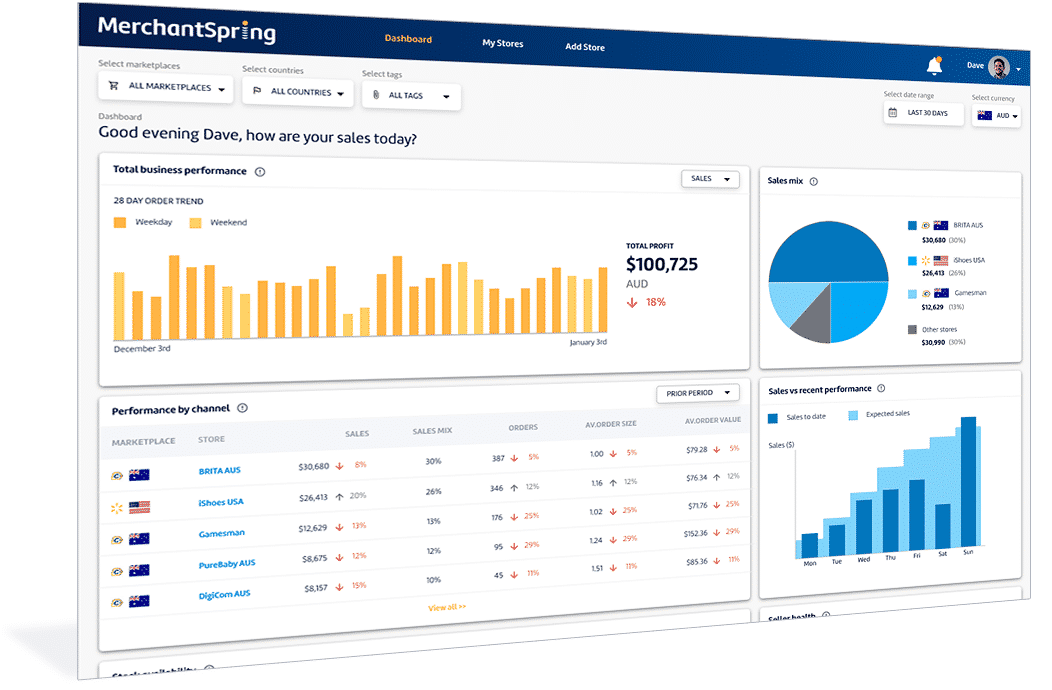
MerchantSpring tools like the Channel Profit report and Marketing Overview give brands clearer visibility into:
- Amazon and fulfillment fees
- Advertising spend and efficiency
- Margin performance by product
Conclusion: It’s Not Growth or Profit — It’s Timing
The real question isn’t whether growth or profitability is better.
It’s when.
Early-stage brands often need to prioritise growth to establish presence. Mature brands may need to shift toward profitability to protect long-term sustainability.
Amazon is more competitive, more expensive, and more complex than it used to be. The brands that win are not simply the fastest growing — they’re the most disciplined.
The right strategy aligns with your lifecycle stage, capital position, and long-term vision.
Growth is powerful.
Profit is sustainable.
The smartest brands know when to lean into each.

About Allison Johnson
Allison Johnson is an Amazon PPC Specialist at Ridgeline Insights, a full-service Amazon agency focused on aligning marketplace strategy with brand goals. She manages advertising for more than 15 well-known brands on Amazon and specializes in helping outdoor and hunting brands improve performance and drive sustainable growth. With strong experience developing tailored advertising strategies, Allison takes a hands-on, data-driven approach to advertising on Amazon, ensuring campaigns are actively optimised — never simply set and forgotten.







Add a Comment